
Elite Property Maintenance LLC • Oklahoma City & Yukon
Heat Pump Repair & Installation in Oklahoma City Comfort in every season.
Heat pump blowing cold air, freezing outside or running on emergency heat? Get the underlying problem diagnosed before spending money on unnecessary repairs or replacement.
Schedule Heat Pump Service1st Time Homeowners School • Heating & Cooling 101
What is a heat pump?
Did you know the equipment sitting outside your house might be your heater AND your air conditioner? A heat pump is an HVAC system that uses electricity and refrigerant to transfer heat rather than generate most of its heat directly. It can cool your home in summer and heat it in winter. Unlike a conventional air conditioner paired with a furnace, a heat pump can reverse its refrigeration cycle.
How does a heat pump work?
Summer: cooling mode
The indoor coil absorbs heat from your home’s air. Refrigerant carries that heat to the outdoor coil, where it is released outside. The indoor blower circulates cooler air through your home.
Winter: heating mode
A reversing valve changes the refrigerant flow. The outdoor coil absorbs heat from outdoor air, even when it is cold. The compressor raises the refrigerant temperature and the indoor coil releases heat into your home.
When temperatures drop in Oklahoma, some systems use auxiliary electric heat or a backup furnace to supplement the heat pump. During defrost, the outdoor fan may stop temporarily and you may see steam as frost melts. That does not automatically mean something is broken.
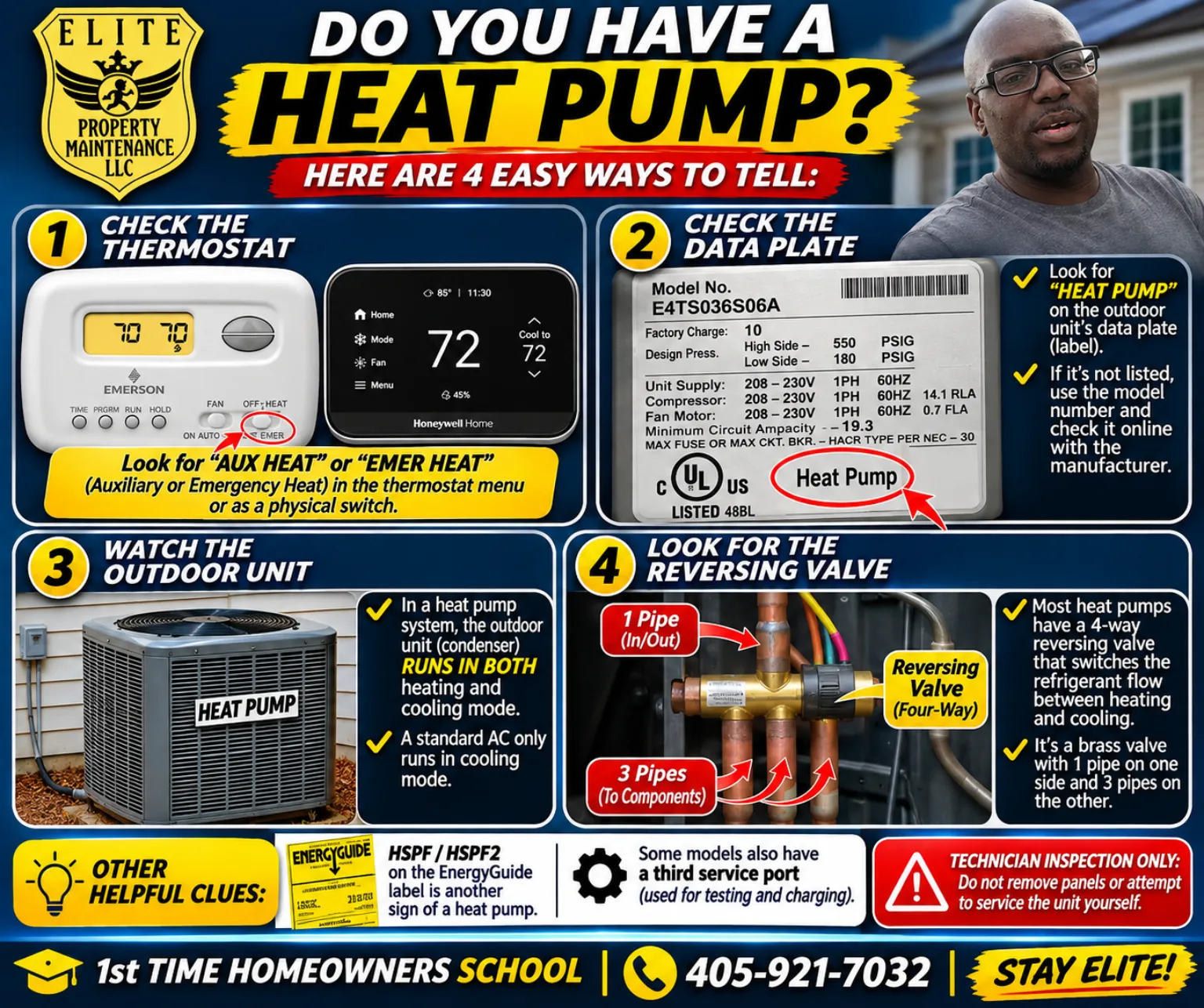
How do you know if you have a heat pump?
Let’s put your homeowner detective skills to work. You don’t need a toolbox for the first three checks.
1. Check your thermostat
Look for AUX HEAT, EM HEAT or EMER HEAT in the mode menu or on a physical switch. These are strong clues, but thermostat configuration alone does not prove what equipment you have.
2. Read the outdoor unit data plate
Look for the words Heat Pump on the manufacturer’s label. If they are absent, record the model number and check the manufacturer’s product specifications. An HSPF or HSPF2 heating efficiency rating is another useful clue.
3. Watch the outdoor unit in heating mode
With your thermostat calling for normal heat, observe the outdoor unit from a safe distance. A heat pump normally operates outdoors in both heating and cooling modes, while a conventional AC operates for cooling. Backup heat, dual-fuel controls, defrost and delays can change this behavior, so an idle outdoor unit does not rule out a heat pump.
4. Identify the reversing valve
A technician can confirm the presence of a four-way reversing valve, which switches refrigerant flow between heating and cooling. Some heat pumps also have an additional service port, but that alone is not definitive. Do not remove panels or touch refrigerant or electrical components.
Homeowner challenge: Find your thermostat’s heating modes and photograph the accessible outdoor model label. Can you identify your system? Do not switch to emergency heat just to test it. If you are unsure, let a professional confirm it.
Want to understand your home before something breaks? Explore our free 1st Time Homeowners School for more practical homeowner education. STAY ELITE!
Find your heat pump problem
Heat pump blowing cold air
Heat pump supply air may feel cooler than furnace air. If the room temperature falls, check thermostat mode and filter; possible causes include refrigerant, reversing valve or backup heat faults.
Emergency heat not working
Verify thermostat mode and accessible breaker position. Backup heat may have a failed relay, sequencer, element or control circuit. Do not open electrical panels.
Outdoor unit covered in ice
Light frost can be normal; persistent solid ice may indicate defrost or airflow failure. Do not chip ice or pour hot water on the coil.
Auxiliary heat stays on
Cold weather, large setpoint changes or loss of compressor capacity may trigger backup heat. Persistent operation in mild weather warrants diagnosis.
Outdoor unit won’t start
Possible control, power, capacitor, contactor or compressor issue. Avoid repeatedly resetting a tripped breaker.
Heat pump runs continuously
Long cycles can be normal for variable-capacity equipment. Falling indoor temperature or excessive energy use warrants evaluation.
High electric bills
Check backup heat use, filter and thermostat schedule. Compare weather and billing periods before assuming equipment failure.
Heat pump short cycles
Possible thermostat, airflow, sizing or safety-control issues.
Water or steam outdoors
During defrost, melting frost and brief vapor can be normal. Persistent ice is not.
Some rooms stay cold
Duct leakage, restricted airflow and insulation may be contributing factors. Explore ductwork services.
Burning odors, smoke, damaged wiring or repeated breaker trips: stop using the equipment and seek professional help. If there is a fire, leave and call emergency services.
Safe checks before calling
- Confirm thermostat is set to heat and the temperature is above room temperature.
- Check filter condition and unobstructed return grilles.
- Observe outdoor frost and note whether defrost clears it.
- Record thermostat messages, temperature and unusual sounds.
- Do not bypass safety controls or open energized equipment.
Heat pump repair costs
Standard diagnostic
Identify the cause before recommending a repair.
After-hours diagnostic
For qualifying after-hours service.
Dual capacitor
Where applicable to conventional equipment.
Contactor
For compatible systems.
Heat pump replacement
Equipment and installation requirements vary.
Actual repairs depend on equipment and diagnosis. See our HVAC estimator and financing options.
Auxiliary heat vs. emergency heat
Auxiliary heat
Supplemental heating when required by configured controls.
Emergency heat
Backup-only operation on many heat pump thermostats.
Backup behavior depends on the thermostat, equipment and wiring. A cold-air complaint does not automatically mean the compressor has failed.
Compare your estimated heating electricity cost
Illustrative equal-heat comparison with resistance heating. Excludes backup operation, demand charges and fixed fees. Actual COP varies with conditions.
Understand common components
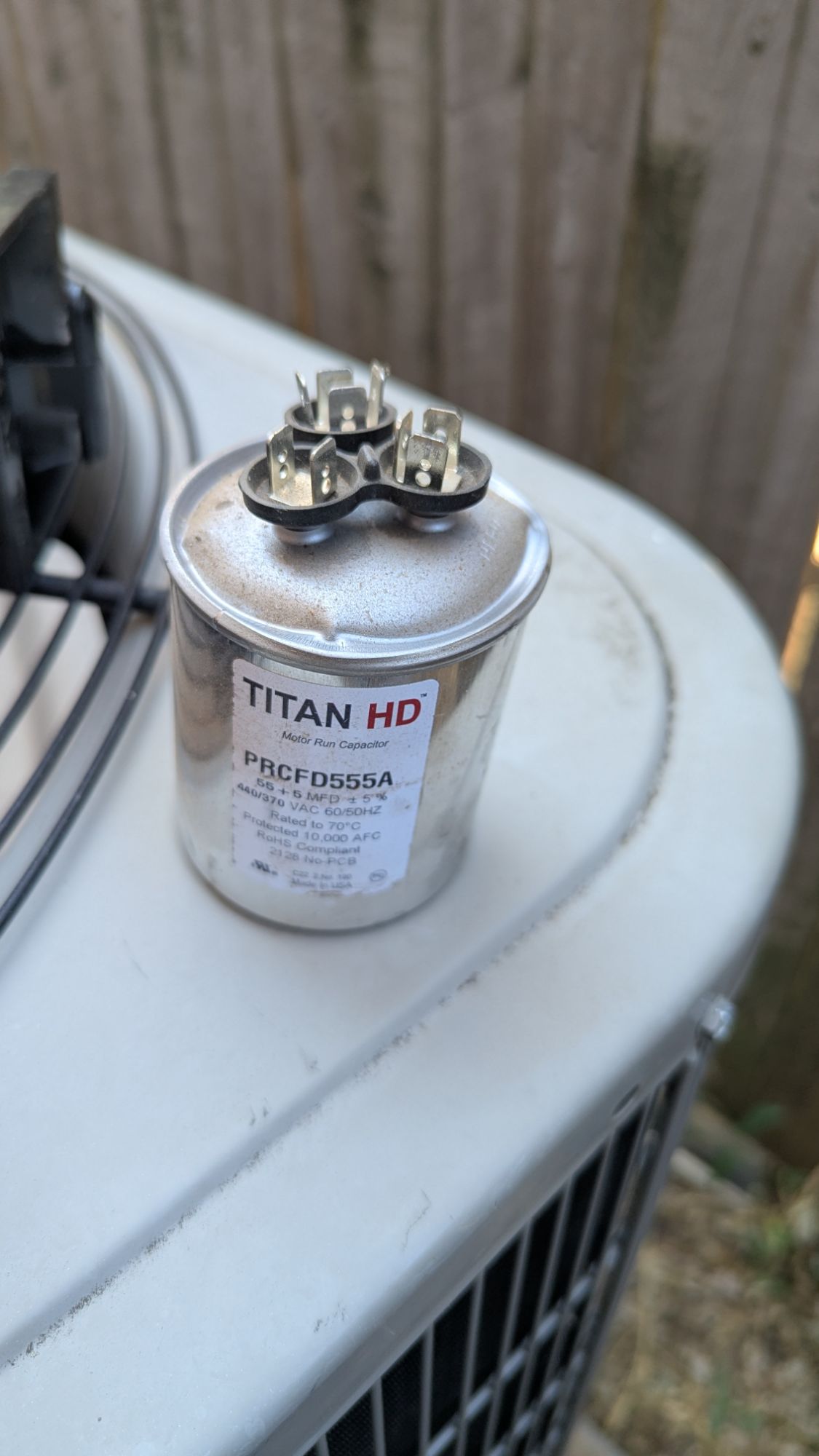 Dual capacitor+
Supports motor starting and running on compatible conventional units.
 Contactor+
Switches power to outdoor equipment on compatible designs.
 Compressor+
Circulates refrigerant and supports heat transfer.
 Blower assembly+
Moves indoor air across the coil.
 Thermostat+
Controls heating, cooling and configured backup stages.
Reversing valve+
Routes refrigerant between heating and cooling modes.
Defrost controls+
Monitor conditions and initiate or terminate defrost according to equipment design.
Electric heat strips+
Provide supplemental resistance heat where installed.
These company equipment photos illustrate shared HVAC components, not necessarily heat pump-specific installations.
Repair, replace or upgrade?
Repair existing equipment
Evaluate fault, warranty, condition and repair cost.
New heat pump
Assess heating load, low-temperature capacity, indoor equipment and electrical supply.
Dual fuel
Combine compatible gas furnace and heat pump controls when appropriate.
Explore our complete HVAC replacement or furnace installation services. For independent equipment selection guidance, see ENERGY STAR air-source heat pumps.
What to expect from Elite
Inspect
Review symptoms, thermostat and equipment.
Test
Check applicable electrical, airflow and refrigeration conditions.
Explain
Provide findings and repair or replacement options.
Verify
Confirm operation following approved work.
Explore seasonal AC maintenance and furnace maintenance for compatible equipment.
Heat pump frequently asked questions
How does a heat pump work?
It moves heat indoors in winter and outdoors in summer using a refrigerant circuit.
Is a heat pump the same as an AC?
A heat pump can reverse its refrigeration cycle to heat as well as cool.
What is auxiliary heat?
Automatic supplemental heat when the primary system needs assistance.
What is emergency heat?
A manually selected backup-only mode on many systems, generally bypassing the compressor.
Should I leave emergency heat on?
Use it when instructed for a primary heat failure; electric resistance backup can be costly.
Why does AUX appear on the thermostat?
Controls may call for supplemental heat during cold weather, recovery or defrost.
What is a defrost cycle?
A temporary operating mode that melts outdoor coil frost.
Is steam from the outdoor unit normal?
Brief vapor during defrost can be normal if there is no burning odor or smoke.
Why is the outdoor fan stopped?
Some defrost modes stop the fan temporarily; prolonged stoppage during a normal call requires evaluation.
Can a heat pump work below freezing?
Yes. Capacity and efficiency vary by model and temperature; backup may be needed.
What is a cold-climate heat pump?
Equipment designed and rated for improved low-temperature performance.
What is dual fuel?
A compatible heat pump paired with a combustion furnace for backup heating.
Can I keep my gas furnace?
Possibly, if controls, coil and equipment compatibility are confirmed.
Can I replace just the outdoor unit?
Only if a compatible indoor coil and other equipment can be confirmed.
What is a reversing valve?
A refrigerant-routing valve that changes heating and cooling operation.
What is a defrost board?
A control that manages defrost operation using model-specific inputs.
What is a heat strip?
An electric resistance heating element used in compatible air handlers.
Why is heat strip operation expensive?
Resistance heating typically delivers about one unit of heat per unit of electrical energy consumed.
What is COP?
Coefficient of performance: delivered heat divided by electrical energy input under specified conditions.
What is HSPF2?
A standardized seasonal heating efficiency rating.
What is SEER2?
A standardized seasonal cooling efficiency rating.
What size heat pump do I need?
A load calculation and equipment performance data determine appropriate sizing.
Is larger equipment better?
Oversizing can contribute to cycling and comfort issues.
Can low refrigerant cause poor heating?
Yes. A technician should investigate leakage and verify charge using manufacturer procedures.
Does refrigerant need annual topping off?
No. Loss of charge indicates a condition that requires investigation.
Can a dirty filter cause heating problems?
Yes. Restricted airflow can reduce performance and trigger safety faults.
How often should I replace filters?
Follow filter and equipment instructions; inspect regularly and replace when dirty.
Should I use large thermostat setbacks?
Large recovery changes can activate backup heat on some systems. Use manufacturer guidance.
Why does my breaker trip?
Electrical faults or overloads require evaluation. Do not repeatedly reset the breaker.
How much is a diagnostic?
Standard diagnostic $85; after-hours diagnostic $125.
How much does replacement cost?
A heat pump-specific estimate depends on capacity, equipment, backup heat and site conditions.
Do you offer financing?
See financing options. Approval and terms vary.
Should I repair or replace?
Compare actual quotes, warranty, safety, reliability and expected operating expenses.
Do heat pumps need maintenance?
Yes. Seasonal inspection, clean filters and unobstructed coils support performance.
Where do you provide service?
Oklahoma City, Yukon and surrounding metro communities, subject to coverage and scheduling.
Serving Oklahoma City and Yukon
Need urgent assistance? See our emergency service.
Get your heat pump working correctly.
Schedule a diagnostic or request a replacement estimate.
Schedule Heat Pump Service